The global data center industry is facing an unprecedented operational crisis: a **power crunch**. Rapidly escalating energy costs, exemplified by the PJM grid’s 76% Year-over-Year jump to $136.53/MWh, are fundamentally challenging the traditional economic model of compute infrastructure. Simply building bigger data centers is no longer a viable strategy; profitability now hinges entirely on **energy efficiency** and advanced power management.
The Economic Imperative: Why Power Costs Are the New Bottleneck
The core challenge is clear: the **rampant demand from data centers** is colliding with volatile and skyrocketing energy prices. Traditional air cooling methods, while reliable, are inherently inefficient when dealing with the high-density compute loads of modern AI and ML workloads. This inefficiency translates directly into massive operational expenditure (OpEx). Infrastructure architects and IT operations teams are now forced to prioritize metrics like **Power Usage Effectiveness (PUE)** and **Water Usage Effectiveness (WUE)** above all else.
The industry narrative has shifted from ‘scale at all costs’ to ‘efficiency and density.’ Advanced cooling is no longer an optional upgrade; it is a core business requirement for survival in high-cost energy markets.
Pivoting to Liquid Cooling: The Architectural Solution
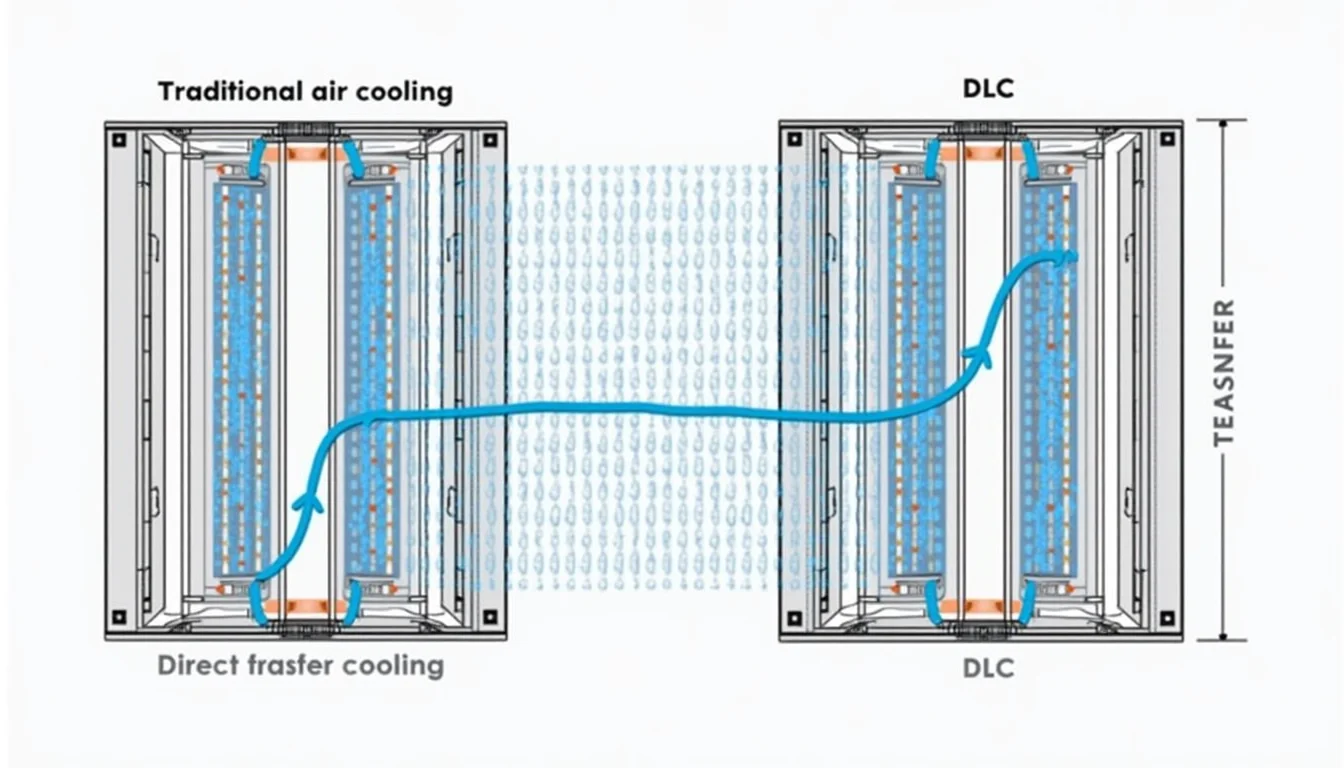
The technical answer to the power crunch is a fundamental architectural pivot toward liquid cooling. These advanced methods—specifically **Direct Liquid Cooling (DLC)** and **Immersion Cooling**—offer superior thermal management that traditional air cooling cannot match. By circulating coolant directly to the heat source (the chips and components), these systems drastically reduce the energy overhead associated with cooling the entire facility air volume.
How it works:
- Direct Liquid Cooling (DLC): Coolant is piped directly to cold plates mounted on high-power components (CPUs, GPUs). This allows for unprecedented **power density (kW/rack)** and significantly lowers the PUE.
- Immersion Cooling: Servers are submerged in a non-conductive dielectric fluid. This method provides the most efficient thermal transfer, enabling extreme density and minimizing energy waste.
The ROI calculation for these technologies is now central to infrastructure planning. The energy savings and ability to handle higher compute loads make the initial investment in liquid cooling a critical **strategic asset**.
Operationalizing the Shift: Challenges and Best Practices
While the benefits are clear, the shift to liquid cooling introduces new operational complexities. Infrastructure teams must move beyond traditional HVAC management and adopt specialized skills in fluid dynamics, plumbing, and coolant management. This requires a comprehensive overhaul of operational protocols.
To successfully navigate this transition, organizations must:
- Conduct a Thermal Audit: Identify the highest power density racks and model the cooling requirements accurately.
- Revise Staff Training: Invest heavily in training IT Ops staff on specialized fluid handling and DLC maintenance.
- Optimize the Stack: Design the data center architecture to integrate coolant loops seamlessly, treating cooling infrastructure as integral to the compute stack.
The future of data centers is not merely bigger; it is **smarter**, **denser**, and fundamentally **liquid**. Embracing these advanced cooling methods is the defining architectural move for any enterprise aiming to maintain profitability in the modern, energy-constrained computing landscape.
For deeper insights into sustainable infrastructure design, consult resources like the Green Technology Council. Furthermore, understanding the technical standards for these systems is crucial, making publications from the Uptime Institute invaluable for architects.