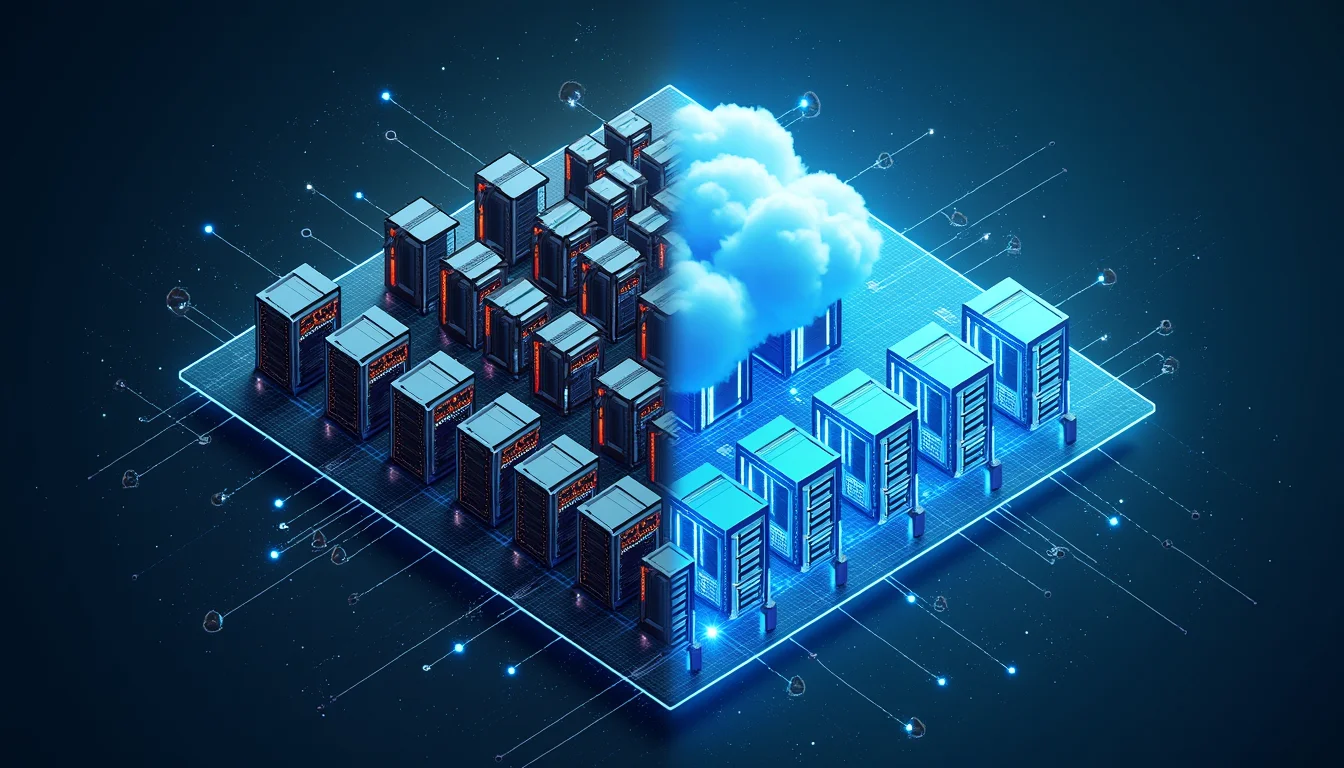
The pace of artificial intelligence adoption has moved far beyond the realm of experimental projects. Today, AI is a core, mission-critical engine driving global enterprise transformation. But this rapid growth comes with a staggering computational demand, forcing enterprise leaders to confront a fundamental architectural decision: how to scale.
The numbers are staggering. AI compute demand has skyrocketed from 9.7T tokens two years ago to a current requirement of **3.2 quadrillion tokens per month**. This exponential growth—a factor of over 300x in just two years—is not merely a technical hurdle; it is a strategic inflection point for every major corporation. The sheer scale demands a complete re-evaluation of traditional IT infrastructure.
The Compute Crisis: Understanding the Scale of AI Demand
The metric of **3.2 quadrillion tokens per month** represents the current operational reality. This volume of data processing requires highly parallelized, petascale compute clusters, utilizing specialized AI accelerators like TPUs and high-end GPUs. The challenge is that matching this scale on-premise is becoming prohibitively complex and expensive.
The industry is facing a classic dilemma: Do you invest billions in proprietary, on-premise hardware (CapEx), or do you embrace the elastic, pay-as-you-go model of hyperscale cloud providers (OpEx)?
Why Cloud-Native Architecture is the Strategic Imperative
The analysis of the current market trajectory overwhelmingly favors a ‘Cloud-First’ strategy. Attempting to replicate the agility and scale of a hyperscaler’s backend compute resources—which include not just hardware, but specialized cooling, power grids, and talent—is a monumental undertaking for most enterprises.
Cloud vs. On-Premise: A TCO Analysis
The Total Cost of Ownership (TCO) calculation must account for far more than just the initial hardware purchase. It must factor in specialized talent, power consumption, and the inevitable scaling bottlenecks.
- Cloud Advantages: Cloud providers offer **elastic scalability**, allowing instant scaling to meet unpredictable demand spikes. They provide **managed services**, offloading the complexity of hardware maintenance and model optimization. This dramatically reduces the time-to-market for AI solutions.
- On-Premise Disadvantages: On-premise solutions suffer from **high CapEx**, requiring massive upfront investment in rapidly depreciating assets. Furthermore, scaling capacity is slow and constrained by physical space and power availability, creating significant operational bottlenecks.
The consensus among industry analysts is clear: the exponential nature of AI growth demands an architecture that can scale instantly and globally. This capability is the defining advantage of cloud-native platforms.
Adopting the Cloud-First Strategy
The strategic recommendation for modern enterprises is to adopt a ‘Cloud-First’ approach. Utilize hyperscalers’ AI/ML platforms for all core, high-volume workloads. This allows the enterprise to focus its limited resources on data governance and model refinement, rather than infrastructure management.
However, the ‘data gravity’ principle remains critical. For highly sensitive, regulated data that cannot leave the local network, on-premise infrastructure should be retained. Crucially, this local infrastructure must be architected to interface seamlessly with cloud services via secure VPNs or dedicated interconnects, ensuring a hybrid, secure operational model.
By adopting this hybrid, cloud-native model, enterprises can harness the massive, scalable power of the cloud while maintaining strict control over their most sensitive data assets, ensuring they are positioned to capitalize on the **3.2 quadrillion token** era of AI.
Learn more about AI infrastructure trends from Gartner.
Explore MLOps best practices for scalable AI deployment at IBM.