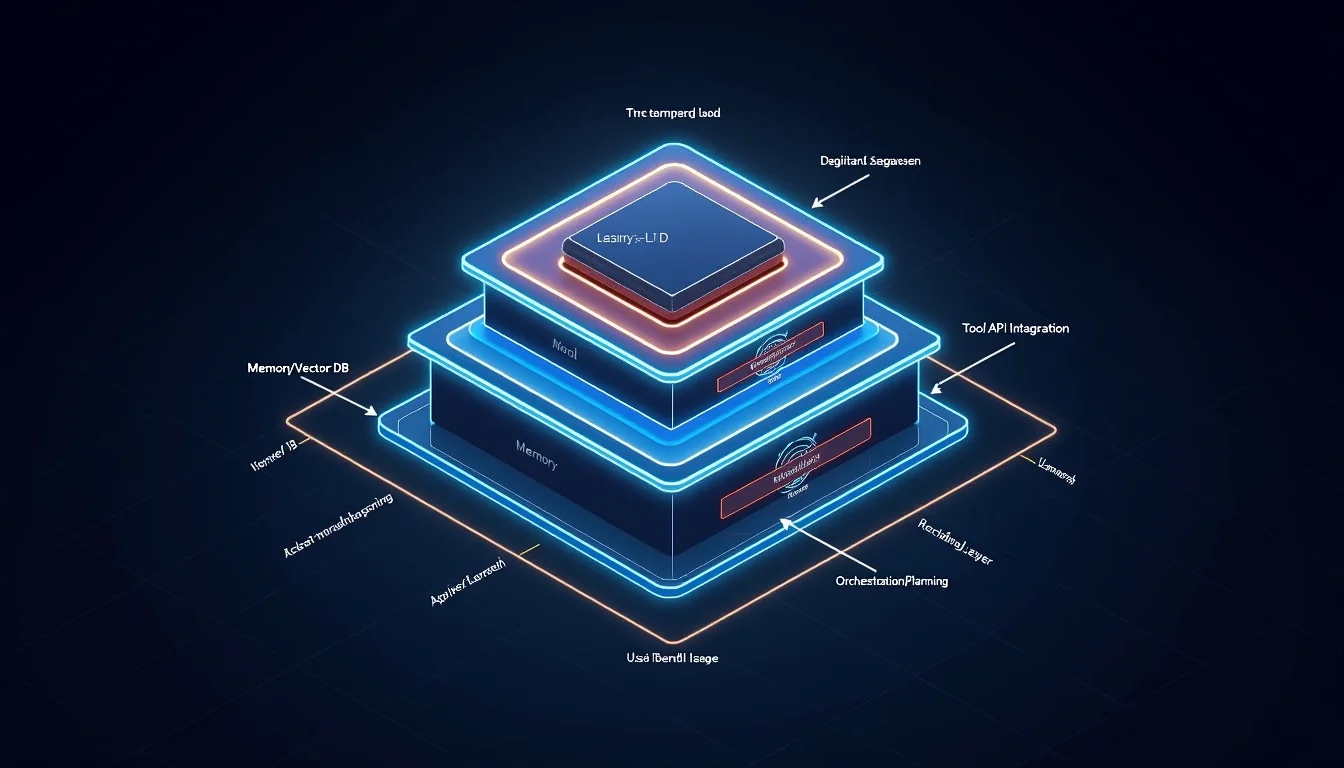
The hype cycle around Generative AI has moved past simple chatbots. The market is now rapidly maturing toward a far more complex, commercially viable frontier: **specialized AI agents**. These agents are not just conversational interfaces; they are autonomous, orchestrated systems designed to operate within the intricate, high-stakes environment of a modern enterprise. The recent funding rounds, such as the $40M Series B for companies like Dust, validate a critical shift: the focus is no longer on ‘what AI can do,’ but on ‘how reliably can AI perform complex, multi-step tasks alongside human teams.’
The Architectural Shift: From LLM Calls to Agentic Workflows
To move AI from the proof-of-concept notebook into production-grade enterprise architecture, developers and CTOs must understand that the core challenge is not the Large Language Model (LLM) itself, but the **orchestration layer** built around it. An LLM provides intelligence; the agent framework provides the reliable, structured workflow.
A truly specialized AI agent must manage three critical components to function reliably in an enterprise setting:
- Contextual Memory: The ability to recall long-term state and conversation history, preventing the ‘forgetting’ that plagues stateless API calls. This often involves integrating vector databases.
- Planning and Reasoning: The module that breaks down a high-level goal (e.g., ‘Process this client’s full onboarding’) into a sequence of executable steps.
- Tool/API Integration: The secure, reliable interfaces that allow the agent to interact with existing enterprise systems like CRM, ERP, or internal databases.
The modern enterprise requirement is for **agentic workflows**—systems that manage state, context, and external actions autonomously, but within a controlled, human-in-the-loop governance model. This is the key differentiator between a simple chatbot and a mission-critical AI agent.
Building Reliability: The Pillars of Enterprise Agent Design
Building these specialized agents requires adopting a modular, robust architectural approach. We must move beyond treating the LLM as a black box and instead focus on the surrounding infrastructure.
1. Orchestration and Multi-Agent Systems
The most advanced agents are often **multi-agent systems**, where different specialized AI components (e.g., a ‘Data Retrieval Agent,’ a ‘Workflow Planning Agent,’ and a ‘Reporting Agent’) collaborate. The orchestration layer acts as the conductor, managing the handoffs, resolving conflicts, and ensuring the overall goal is met. This modularity is paramount for debugging and scaling.
2. Observability and Governance
In a regulated enterprise environment, you cannot afford ‘black box’ failures. Every agentic workflow must be **observable**. This means logging every decision, every tool call, and every context update. Implementing robust monitoring and governance frameworks is non-negotiable for production deployment.
Future-Proofing Your AI Strategy
The market validation for these complex systems is undeniable. Companies are willing to invest heavily in solutions that provide reliable, specialized automation. For organizations looking to adopt this technology, the focus must shift from experimentation to **architectural blueprinting**. Start by identifying high-value, repetitive workflows that currently require multiple human handoffs. These are the perfect candidates for specialized AI agents.
To deepen your understanding of these architectural patterns, consult industry leaders and specialized frameworks. For comprehensive guidance on deploying complex AI systems, review resources from leading cloud providers and specialized MLOps platforms. Understanding the interplay between **vector databases**, **workflow engines**, and **LLM APIs** is the core skill set for the next generation of AI engineers.
Learn more about enterprise generative AI solutions. | Explore market reports on AI platform maturity.