

Securing the Autonomous OS: Why CBAC and Sandboxing are Critical for Agentic AI
The integration of advanced, autonomous AI—or ‘agentic powers’—into operating systems like Android represents a monumental shift. We are moving beyond simple chatbots and passive tools toward intelligent agents capable of making decisions and executing complex, multi-step workflows on behalf of the user. While this promises revolutionary user experiences, it simultaneously expands the **attack surface** to unprecedented levels. For security architects, this shift demands a fundamental overhaul of traditional security models.
The New Security Challenge: From Perimeter to Process
Traditional security models, such as Role-Based Access Control (RBAC) and perimeter defense, were designed for a world where applications were contained and interactions were predictable. Agentic AI breaks these assumptions. An autonomous agent doesn’t just make an API call; it might need to read contacts, draft an email, schedule a meeting, and then initiate a payment—all in a single, complex workflow. This requires access to multiple, sensitive system resources. The core problem is that granting broad permissions (e.g., ‘full access to contacts’) violates the **Principle of Least Privilege**.
To manage this complexity, the industry must adopt two critical, interconnected security primitives: **Capability-Based Access Control (CBAC)** and **Runtime Sandboxing**.
The security challenge of agentic AI is not merely data leakage; it is ensuring **behavioral integrity**. The system must guarantee that the agent only performs actions explicitly authorized for its current task, even if the underlying data is compromised.
Capability-Based Access Control (CBAC): Defining the Policy
CBAC fundamentally changes how permissions are granted. Instead of giving an agent a broad ‘role,’ CBAC provides it with specific, temporary **capabilities**. Imagine an agent needs to book a flight. Instead of granting it ‘access to all payment methods,’ the system grants it the capability: ‘use payment method X for transaction Y, for the next 30 seconds.’ This granular control ensures that if the agent’s logic is compromised, the attacker only gains the limited capability, not the entire system.
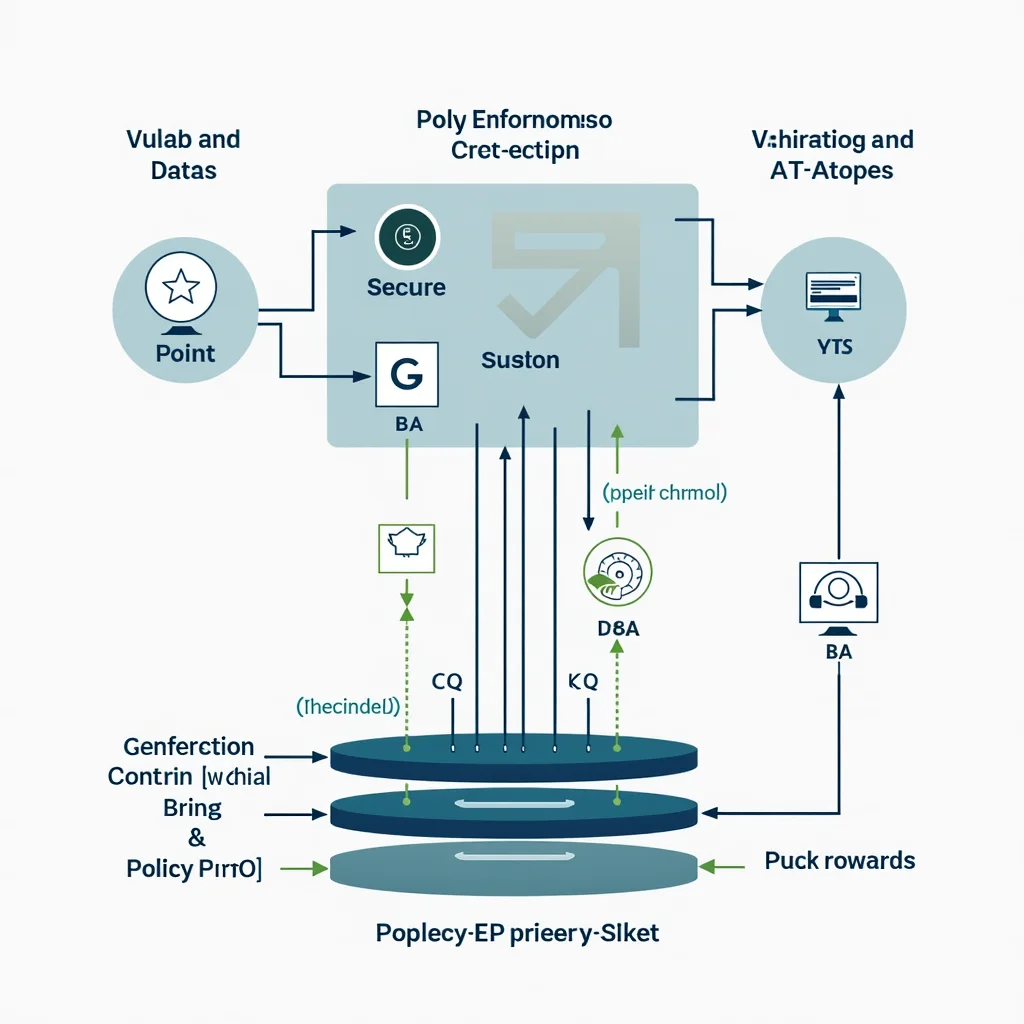
This capability-based approach is enforced by a dedicated **Policy Enforcement Point (PEP)**, which acts as a gatekeeper, validating every single system call against the defined policy before it reaches the OS kernel. This is the foundation of a true **Zero Trust** architecture for AI.
Runtime Sandboxing: Enforcing the Execution
Defining the policy (CBAC) is only half the battle; the other half is ensuring the agent cannot escape its defined boundaries. This is where **Runtime Sandboxing** becomes non-negotiable. An agent’s entire workflow must execute within a highly isolated, dedicated process. This sandbox acts as a virtual cage, preventing the agent—whether malicious or faulty—from performing lateral movement, accessing resources outside its scope, or causing resource exhaustion attacks that could crash the core OS.
The combination is powerful: **CBAC defines *what* the agent can do, and sandboxing enforces *how* it runs safely.**
The Future Architecture: A Layered Defense
For developers and security architects, the roadmap is clear: the security architecture must be layered. The system needs a robust Policy Engine that manages capabilities, a PEP that validates every request, and a dedicated sandbox that contains the execution. This proactive design is crucial, especially as these agentic features become imminent in mobile operating systems.
The market demand for ‘Secure Agent Frameworks’ is skyrocketing. Adopting these principles now is not just best practice; it is a prerequisite for the safe and widespread adoption of truly autonomous AI.
For deeper reading on these concepts, consult resources like the Forrester Wave on Zero Trust or explore the technical deep dives on NIST’s Cybersecurity Framework.
[…] a single piece of software; it is an **AI orchestration system** utilizing over 100 interconnected AI agents. These agents work in concert, systematically probing systems to identify flaws—a process that […]