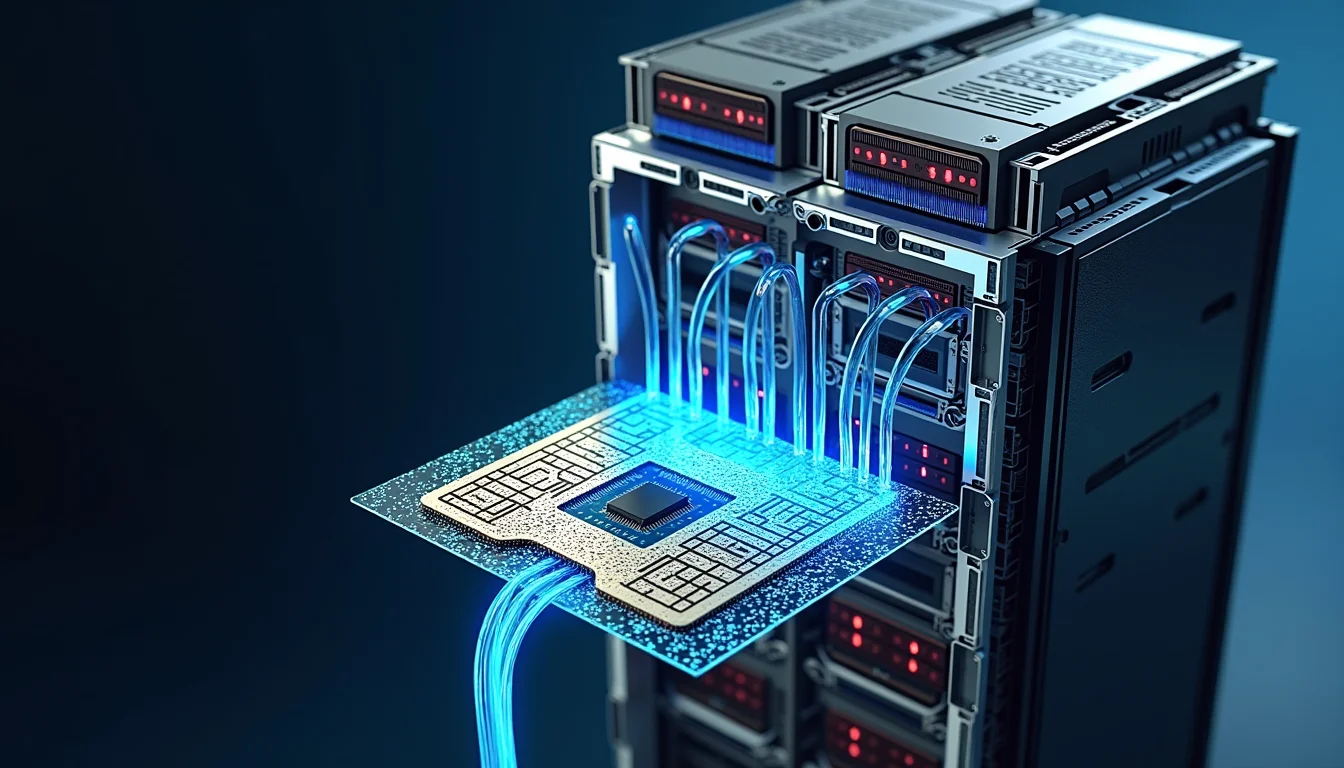
The exponential growth of Artificial Intelligence (AI) is fundamentally reshaping the data center landscape. While the focus often remains on the latest **AI chips**—like Alibaba’s T-Head Zhenwu M890—and their raw computational power, a critical operational challenge is emerging: managing the sheer heat output. The era of air-cooled data centers is rapidly drawing to a close. For enterprises deploying advanced, high-density workloads, particularly complex ‘agentic tasks,’ the limiting factor is no longer compute capacity, but **thermal management** and the associated Total Cost of Ownership (TCO).
The TCO Crisis: Why Cooling is the New Bottleneck
As AI accelerators become more powerful, they generate unprecedented levels of heat density. This intense heat output poses a direct threat to operational stability and economic viability. Simply adding more compute power without upgrading the cooling infrastructure leads to thermal throttling, drastically reducing performance and wasting capital expenditure (CapEx). Infrastructure teams are realizing that the operational expenditure (OpEx) associated with power and cooling is escalating faster than compute gains.
The industry conversation is shifting from ‘buying the fastest chip’ to ‘building the most **efficient data center**.’ This necessitates a strategic pivot toward advanced cooling solutions, making liquid cooling a mandatory component of modern AI infrastructure.
How Liquid Cooling Transforms AI Data Centers
Liquid cooling technologies—including direct-to-chip liquid cooling and immersion cooling—are designed to handle the extreme power densities generated by next-generation AI hardware. By transferring heat directly from the source (the chip) into a liquid coolant, these systems achieve vastly superior heat removal compared to traditional air cooling.
This shift offers several critical advantages:
- Higher Density: Allows data centers to pack significantly more compute power into a smaller footprint.
- Efficiency: Improves Power Usage Effectiveness (PUE) metrics by optimizing energy use.
- Sustainability: Reduces reliance on energy-intensive HVAC systems, lowering the overall carbon footprint.
“The future of AI infrastructure is not defined by the speed of the chip, but by the efficiency of the cooling system that keeps it running at peak capacity. Cooling infrastructure is now as critical as the compute hardware itself.”
Optimizing for Operational Sustainability
For enterprise decision-makers, adopting liquid cooling is not merely a technical upgrade; it is an economic imperative. By managing heat effectively, organizations can ensure continuous, stable operation, maximizing the return on their massive AI investments. This holistic approach requires integrating thermal management into the core data center design, viewing cooling as a foundational utility, much like electricity.
To ensure economic viability, infrastructure planning must prioritize:
- Advanced Thermal Modeling: Predicting heat loads based on anticipated AI workload density.
- PUE Optimization: Selecting cooling solutions that minimize energy waste.
- Scalability: Implementing modular liquid cooling systems that can scale with future AI accelerator generations.
The convergence of high-performance computing and advanced thermal engineering marks the next frontier in **AI & MLOps**. Companies that proactively adopt these liquid cooling strategies will be best positioned to capitalize on the next wave of general AI applications.
For deeper insights into data center efficiency, consult resources like the U.S. Environmental Protection Agency (EPA) guidelines on energy efficiency. Furthermore, industry reports from Gartner on data center infrastructure trends provide crucial data on the accelerating need for liquid cooling solutions.